Number of 2D Shapes Book: A Digital Resource for Kids
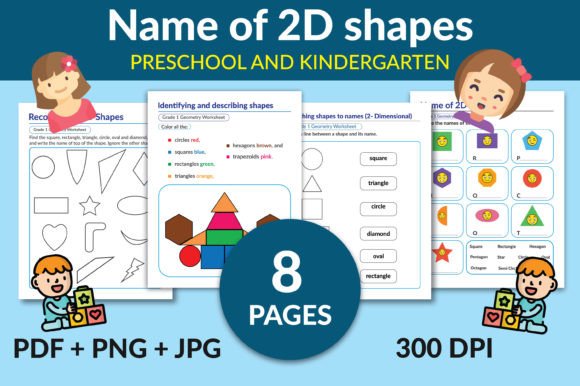
When you see a listing for a Number of 2D Shapes Book for Kids, you're encountering a specific kind of digital product. This isn't a physical book you'd pick up from a bookstore shelf. Instead, it's a ready-to-use, professionally formatted digital file designed for publishing or educational use. Typically, it comprises 8 pages of content focused on teaching young children about basic geometry—circles, squares, triangles, rectangles, and more. The package often includes high-quality 300 DPI image files (both JPG and PNG formats) and a print-ready PDF with bleed settings, making it suitable for platforms like Amazon KDP (Kindle Direct Publishing) where creators can turn it into a tangible activity book.
The core of the product is its function as a shape activity workbook. It provides structured pages where children can count shapes, identify them, and engage in simple related math activities like addition or subtraction. This transforms abstract concepts into a hands-on learning experience. But the value of this resource extends far beyond the child holding the final book. Its significance shifts dramatically depending on who is looking at it and what they intend to do with it.
For Creators and Entrepreneurs: A Launchpad for a Business
For a blogger exploring side hustles, a freelance designer, or a small business owner venturing into self-publishing, this digital interior is a practical starting point. Time and technical skill are often the biggest barriers. Creating a print-ready book from scratch requires knowledge of layout software, understanding of bleed and DPI, and designing engaging, pedagogically sound activities. A pre-made shape activity book interior solves these problems.
Here, priorities are speed, commercial viability, and professional quality. The 300 DPI PDF ensures the final printed product looks crisp, a non-negotiable for customer satisfaction. The inclusion of separate JPG and PNG files offers flexibility; perhaps a creator wants to use the individual shapes in a digital app or on a website. The cost of purchasing such an interior is weighed against the hours it would take to produce it independently. For someone testing the market on KDP, this resource allows them to focus on marketing and distribution rather than spending weeks in design software. It's a low-risk way to validate whether there's demand for educational activity books in their niche.
For Educators and Parents: A Tool for Engagement
A kindergarten teacher, a homeschooling parent, or a preschool activity coordinator views this product through a different lens. Their primary concern is learning value and ease of use. They might not intend to publish a book at all. Instead, they could utilize the high-quality PNG files directly—printing them for classroom worksheets, laminating them for reusable activity stations, or incorporating them into a custom learning packet for their child.
The structure of the book—8 focused pages—is appealing because it's not overwhelming. It provides a complete, coherent lesson unit on shape recognition and counting. For a busy educator, this saves curriculum planning time. The practicality lies in its readiness. They can evaluate it based on the clarity of the shapes, the appropriateness of the accompanying activities for their age group (toddlers vs. pre-K), and whether the visual design is engaging enough to hold a child's attention. A parent looking for supplementary math work might prioritize books that blend shape activities with basic number operations, making this combined resource particularly useful.
Evaluating as a Consumer: Quality and Content Fit
A consumer, perhaps a parent searching online for a math workbook for children, might ultimately buy the physical book created by a publisher using this interior. Their evaluation is direct: does the book help my child? They look for bright, clear images, logical progression, and activities that feel fun rather than tedious. The underlying technical specs like 300 DPI ensure their experience is positive—no blurry, pixelated shapes. Their priority is the long-term usefulness of the book and whether it aligns with their child's developmental stage. They benefit indirectly from the professional packaging of the original digital product, as it translates into a higher-quality physical item.
How Your Goals Shape Your Choice
Determining if a Number of 2D Shapes Book for Kids digital package is right for you depends entirely on your project's nature and your own skills.
- If you are a creator or entrepreneur with limited design experience but a desire to publish, this offers a reliable, professional foundation. Check that the file formats match your publishing platform's requirements and that the style aligns with your brand.
- If you are an educator or parent seeking ready-to-use activities, assess the content depth. Does it cover the shapes you need? Are the activities purely recognition, or do they include the counting and simple math you want? The availability of individual image files might be a key selling point for your flexible, non-commercial use.
- If you are an experienced designer or publisher, you might evaluate it for efficiency. Could customizing this base save you time compared to a ground-up build? Your priority might be the flexibility of the layered files or the correctness of the bleed setup.
Ultimately, this single product serves multiple journeys. It’s a commercial asset for one, a classroom resource for another, and the source of a child's learning moment for a third. Recognizing where you stand on that spectrum is the first step in deciding if this shape activity book interior is the tool you need. By focusing on the practical outcomes—a book to sell, a worksheet to print, a concept to teach—you move beyond generic keywords and see the resource for what it truly offers: a bridge between an idea and its real-world application.