Unlocking Your Daily Patterns: The Day Rating Tracker Canva Template
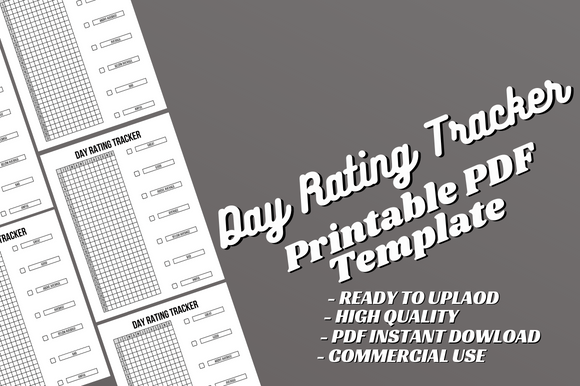
The simple act of reflecting on your day holds immense power. It can reveal patterns in your mood, productivity, and overall well-being, turning vague feelings into actionable data. For many, however, creating a consistent tracking system from scratch is a hurdle. The Day Rating Tracker - Canva Template is designed to remove that barrier, offering a professionally designed, fully editable 120-page interior template ready for print or digital use.
This isn't just a static PDF. You receive a complete, print-ready PDF file formatted for Amazon KDP and similar platforms, alongside an editable Canva source file. This dual offering means you can upload the polished PDF immediately, or dive into Canva to customize every element—fonts, colors, text, layouts—to match your personal style or brand identity. The specification is clear: 8.5x11 inches, no bleed, high-quality. It’s an interior template, so you create your own cover, giving you full creative control from start to finish.
Why a Structured Tracker Matters More Than a Simple Journal
A blank notebook offers freedom, but also demands discipline. A template provides structure, guiding your reflection and ensuring you capture consistent metrics over time. The Day Rating Tracker Canva Template provides that framework. For a busy professional, it might be a tool to correlate work stress with overall day ratings. For someone focusing on mental wellness, it could highlight triggers and positive influences. The act of assigning a rating forces a brief, meaningful summation that, over months, creates a clear emotional and experiential timeline.
This practical utility is why the template resonates across different lives and professions. A blogger might use it to track content creation days versus administrative days, seeking patterns in their most productive states. An educator could adapt it for a classroom activity, teaching students about self-awareness and data tracking. The editable nature means it's not locked into one use case; it’s a starting point that morphs to fit the user’s unique need.
From Beginner to Creator: Different Paths to the Same Tool
For a beginner interested in self-help or mood tracking, the primary value is ease and readiness. The fact that the PDF is complete and tested for KDP means they can print a beautiful, functional journal without any design skills. Their priority is quality and reliability—a tool that works out of the box and helps them build a new habit without technical friction.
A creator or entrepreneur, however, looks at the editable Canva file first. Their evaluation centers on flexibility and commercial value. They can customize this template, add their branding, and potentially use it as part of a larger product offering or as a lead magnet for their audience. Their question isn't just "Does this work?" but "How can I make this uniquely mine and serve my business goals?" The template’s adaptability answers that directly.
Freelancers and small business owners often operate in a gray area between these perspectives. They need a professional tool for their own productivity tracking, but also appreciate the potential to repurpose elements for client reports or project management visuals. The long-term usefulness for them combines personal benefit with peripheral professional application.
Evaluating Priorities: What Matters Most to You?
Identifying whether this template aligns with your goals starts by asking what you prioritize. Is it speed? The ready-to-upload PDF offers instant deployment. Is it creativity and personalization? The Canva link opens that door. For many, the combination is the key benefit—having a polished product immediately available, but retaining the power to edit later as needs evolve.
Consider the learning value. Using a structured tracker teaches you about your own rhythms. For a hobbyist interested in data visualization of their personal life, this template is a practical learning tool. For a marketer, understanding daily energy fluctuations might inform their best times for creative work versus analytical tasks. The template becomes a mirror, and its design quality ensures you enjoy looking into it regularly.
Cost, of course, is a factor. Compared to hiring a designer or purchasing a one-off physical journal, a reusable, editable digital template represents significant value. You aren’t buying a single book; you’re buying a system you can reproduce, modify, and use indefinitely for yourself or a community.
Practical Applications Across Audiences
Let’s move from abstract benefits to concrete examples. A life coach purchases the template, customizes the color scheme and fonts in Canva to match their brand’s calming aesthetic, adds a few guiding questions in the margins, and provides it as a complimentary tool for new clients. It enhances their service package without extra design cost.
A parent, perhaps juggling work and family, uses the unedited PDF. Each evening, they quickly rate the day and jot a line about the highlight. After 120 days, they review the log and notice a pattern: days following certain routines consistently score higher. This data-driven insight helps them tweak their family schedule for better outcomes.
An experienced KDP publisher sees this as a reliable interior for a niche they’ve identified—say, mindfulness journals. They take the Canva file, adjust the layout slightly, pair it with a cover they design, and launch a new product in their catalog with minimal interior development time. Their priority is professional presentation and market compatibility.
Making the Decision: Is This Your Next Step?
The Day Rating Tracker Canva Template is fundamentally a tool for empowerment through structure. It matters to the beginner because it simplifies entry into self-tracking. It matters to the professional because it can be seamlessly integrated into a workflow or business. It matters to the creator because it is a malleable asset.
If your project requires a unique, from-scratch design with complex illustrations, this might be a starting block rather than the final product. But if you need a high-quality, print-ready foundation for a day rating or mood tracking journal—whether for personal use, client gifts, or commercial sale—its specifications and dual-format delivery address core needs directly.
Ultimately, its usefulness grows from your engagement with your own days. By providing a clear, attractive, and adaptable framework for that engagement, the template removes the initial design obstacle and lets you focus on what matters most: understanding your patterns, one day at a time.